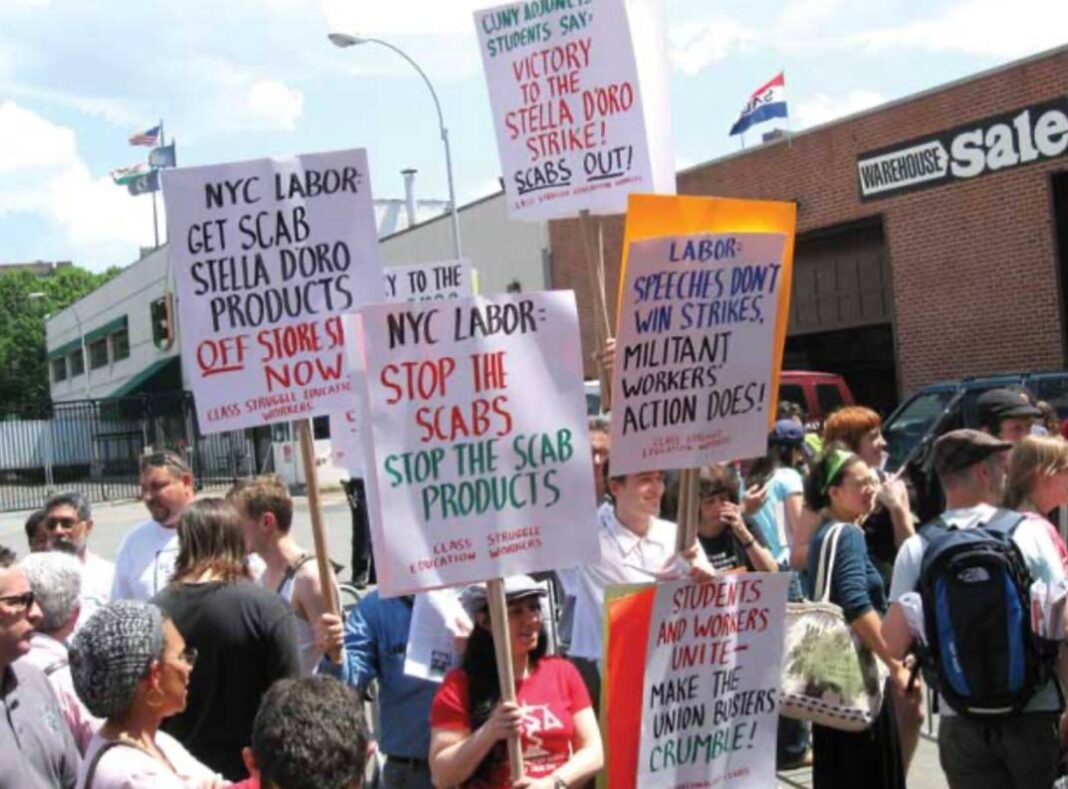

The strike at Stella D’oro became a symbol of the workers’ struggle in the United States. It showed how a small community could unite against corporate pressure, stand up for their rights, and draw attention to social justice. While many lost their jobs, the workers maintained their dignity and continued the fight for employees’ rights in the Bronx and beyond. Here is this story of a battle for resilience and dignity on bronx-yes.com.
The History of a Cookie That Became a Legend
In the 1930s, at the corner of 237th Street and Broadway in the Bronx, the smell of fresh baking became a part of the neighborhood’s life. It was then that Joseph and Angela Cressevich, Italian immigrants, founded the Stella D’oro company. They chose a different path from most American cookie manufacturers. Their treats were less sweet and more refined, making them perfect for coffee or tea. One of their wisest moves was to make the cookies without dairy products, which kept them kosher.

This opened the door to a huge group of loyal customers. Over the years, the small bakery grew into a true factory, and after Joseph’s death in 1965, the management was taken over by Angela’s stepson, Felice (Phil) Zambetti. His employees recalled that period as the “reign of a good king.” Stella D’oro expanded its markets, opened new factories, increased wages, and provided people with insurance, pensions, sick leave, and even four weeks of paid vacation.
The Zambetti family lived for this business. Phil’s children spent their days at the factory, and his sons Mark and Jonathan dreamed of one day running the company. But tragedy shattered those plans. In 1989, Mark died in an earthquake in San Francisco. The family was devastated, and in 1992, they decided to sell the company to the giant RJR Nabisco for over a hundred million dollars.
But within the giant’s structure, Stella D’oro quickly got lost. For a corporation where the single Oreo brand brought in a billion dollars, sales of a few tens of millions seemed insignificant. The quality of the cookies began to decline—cheaper ingredients were used, the brand lost its status, and customers left. Revenue fell by half, hundreds of workers were laid off, and factories outside the Bronx were closed.
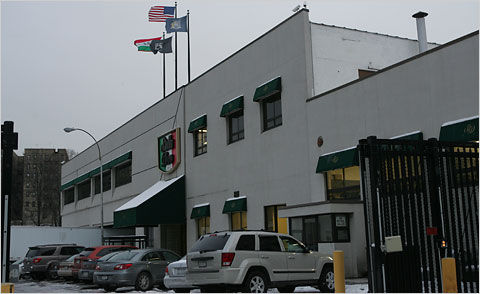
In 2006, the company was bought for a pittance by the investment fund Brynwood Partners, which began to introduce new rules. But its plans to cut costs were met with resistance. The workers, who remembered the times of the generous Stella D’oro, refused to accept wage and benefit reductions. For them, it wasn’t just a workplace but a way of life that allowed their children to go to college and build a future.
Picket lines, lawsuits, angry letters—the struggle for Stella D’oro became a symbol of the confrontation between a family business and the cold logic of corporations. For many Bronx residents, the trucks with the white and gold emblem leaving the factory for stores weren’t just delivering cookies—they represented the rhythm, smell, and taste of their childhood.
A Fierce Fight for Justice and Dignity
October 8, 2008, was a black day for the workers of Stella D’oro in the Bronx. After long shifts that started in the morning with kneading dough and sending it to the ovens, management called the staff at 3:00 PM and coldly announced,
“That’s it—you’re all fired.”
One hundred and thirty-six people, including veterans with over thirty years of experience, were left without jobs. They were denied the payouts stipulated in their union contract. But before leaving the factory, they chanted,
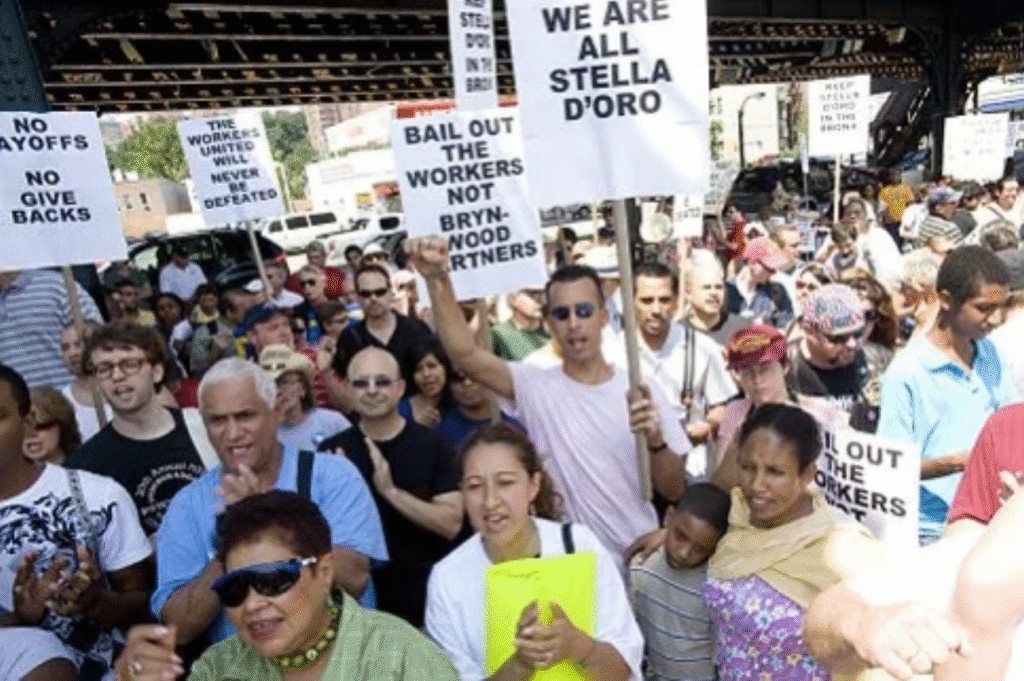
“United workers will never be defeated!”
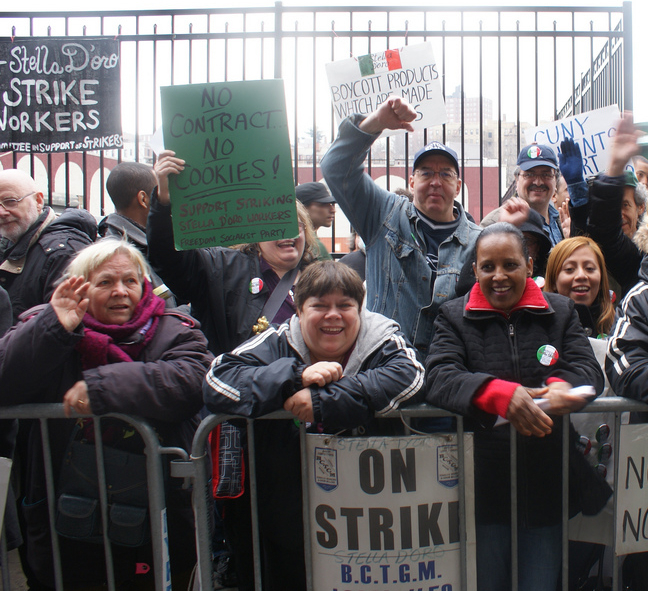
This was part of their 11-month struggle—a strike that became a legend in the Bronx. Most of the bakers were of Latin American descent, and they were fighting not only for wages but for their dignity. Their resistance earned the respect of the entire labor movement; neighboring unions, communities, and clergy joined the rallies.
Brynwood Partners, the brand’s owner, never hid the fact that they didn’t need the factory, only the profit. They even rejected four offers to sell the plant to companies willing to preserve jobs in the Bronx. Protests erupted all over New York: from the factory gates to City Hall, from Broadway to the skyscrapers of Goldman Sachs.
City council member Avella couldn’t hold back his emotions:
“What a disgrace that Mike Bloomberg and the city of New York are allowing this to happen without any explanation, without even showing any concern for the workers. The mayor has a fiduciary responsibility to protect city property. We bought this equipment—and we must demand that Mike Bloomberg stop this now. Shame on him if he doesn’t do it immediately.”
When the factory doors were finally locked, people just stood silently with their signs. Many were crying. Along with the workers, the smell of baking that had enveloped the neighborhood for sixty years also disappeared.
The strikers succeeded in having their position vindicated. An administrative law judge for the National Labor Relations Board found Brynwood guilty of unfair labor practices, including refusing to provide a 2007 financial report, illegally firing strikers, and refusing to negotiate. The judge ordered the workers to be reinstated immediately and paid back wages. The workers celebrated their victory with a party at the factory gates, but almost immediately, it became known: the plant would be sold to Lance and moved to Ohio.
For the remaining weeks, the Stella D’oro workers tried to prevent the move. They wrote letters to Mayor Bloomberg, met with their union, called the borough president, and even humorously appealed to Venezuelan President Hugo Chávez to buy the company through Citgo. Brynwood ignored all requests.
The Bitter Taste of Victory: Lessons from the Stella D’oro Strike
The Stella D’oro strike became a symbol. A small factory with a few hundred workers attracted the attention of the national press, politicians, and unions. People saw it as a metaphor for the entire country, where corporations could, with a single decision, erase the lives of hundreds of families. But defeat was inevitable. There were several reasons for this:
- Lack of real support from union leadership.
Although teachers, nurses, and activists were present at the rallies, major union federations like the AFL-CIO limited themselves to words of solidarity. A massive mobilization capable of blocking the factory or logistics never happened.
- A flawed reliance on a boycott.
The leaders of Local 50 promoted a “don’t buy the cookies” strategy, which made sense in a large industry but was powerless for a small factory. The strike would have only succeeded by halting production and distribution, but they didn’t dare to do so.
- Illusions about “friendly” politicians and courts.
When the National Labor Relations Board ruled that the workers had been illegally fired, many called it a victory. But the very next day, Brynwood announced the factory’s closure. Capitalist courts did not serve as a shield for the workers.
- A split within the left-wing activist community.
Some demanded mass action and blockades of supplies, while others bet on pressuring Democrats. As a result, the strike dispersed its energy instead of focusing on direct action.
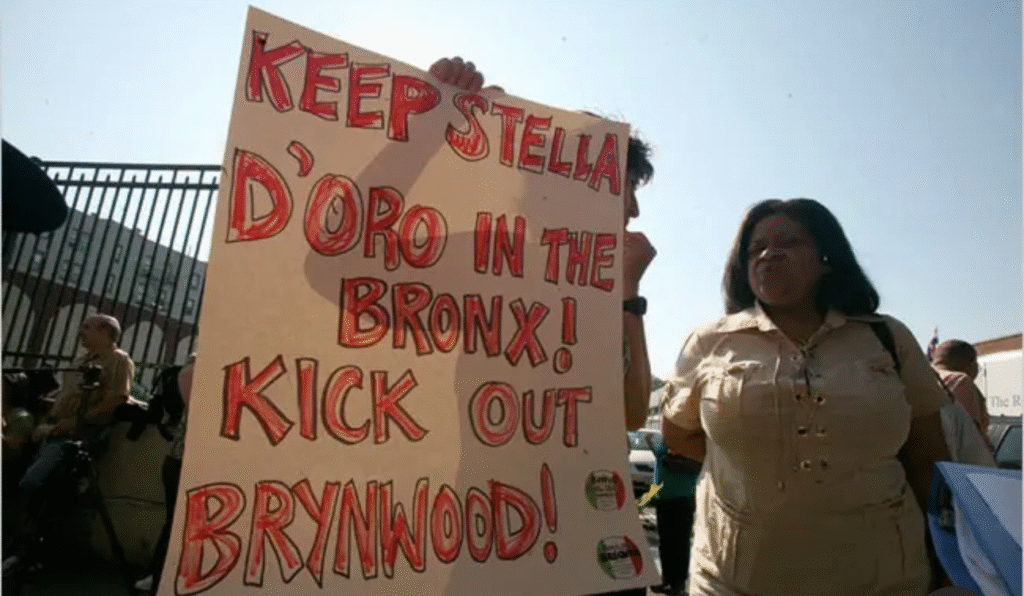
The unity and determination of the workers were not a guarantee of success. They were flawless; for nearly a year and a half, no one betrayed the picket line. But without broad support from the rest of the labor movement, it was not enough.
The Merging of Two Tragic American Cookie Stories
The fate of the Archway factory in Ashland, Ohio, has many parallels with Stella D’oro. The story is almost a mirror image: a company founded by a couple in the 1930s gradually grew into a national brand. Its soft, home-style cookies were loved all over America. But when it was acquired by Catterton Partners of Connecticut, management was outsourced to Insight Holdings, and catastrophic changes began. The use of cheaper ingredients ruined the quality of the product, followed by outright fraud with fake sales and loans. In October 2008, workers came to their shift and found the gates locked. The next day, all 278 employees were sent letters of immediate termination.
Ashland lost not only its largest employer but also the health insurance for hundreds of families. The mayor of Ashland, Glen Stewart, unlike the owners, acted as a true representative of the community. He personally traveled to Delaware to testify before the bankruptcy court. The judge told him,
“Your actions may influence my decision.”
And they did: the factory was sold to the Lance, Inc. corporation, which resumed production a month later. However, out of 278 employees, only 60 were hired back at first, and later 150. They worked without a union and for lower wages.
And it was here, in Ohio, that the paths of Stella D’oro and Archway converged. In 2009, Lance bought Stella D’oro as well for “a ridiculous amount of money,” less than the $25 million it had paid for Archway. The name of the legendary factory from the Bronx moved to Ashland.
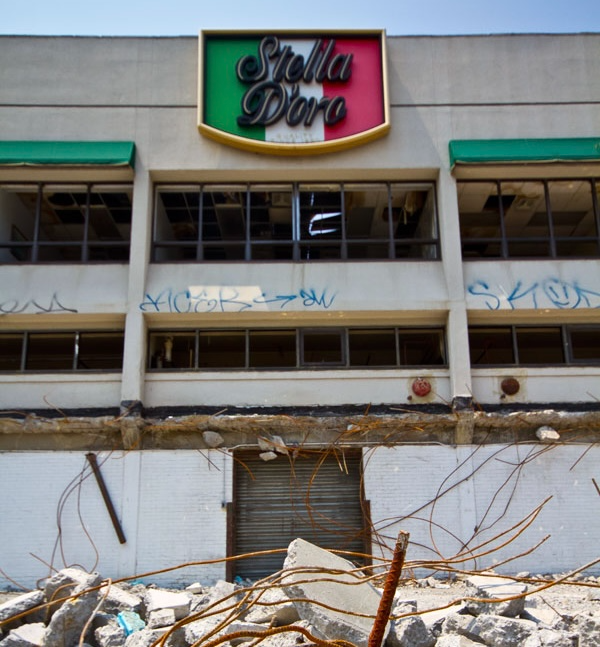
In the end, in both the Bronx and Ashland, it was not the workers who won, but the corporations. Jobs were partially saved, conditions worsened, and the only unchanging witness to the struggle was the smell of fresh cookies, which would disappear and then return—warm and spicy, like a memory of better times.