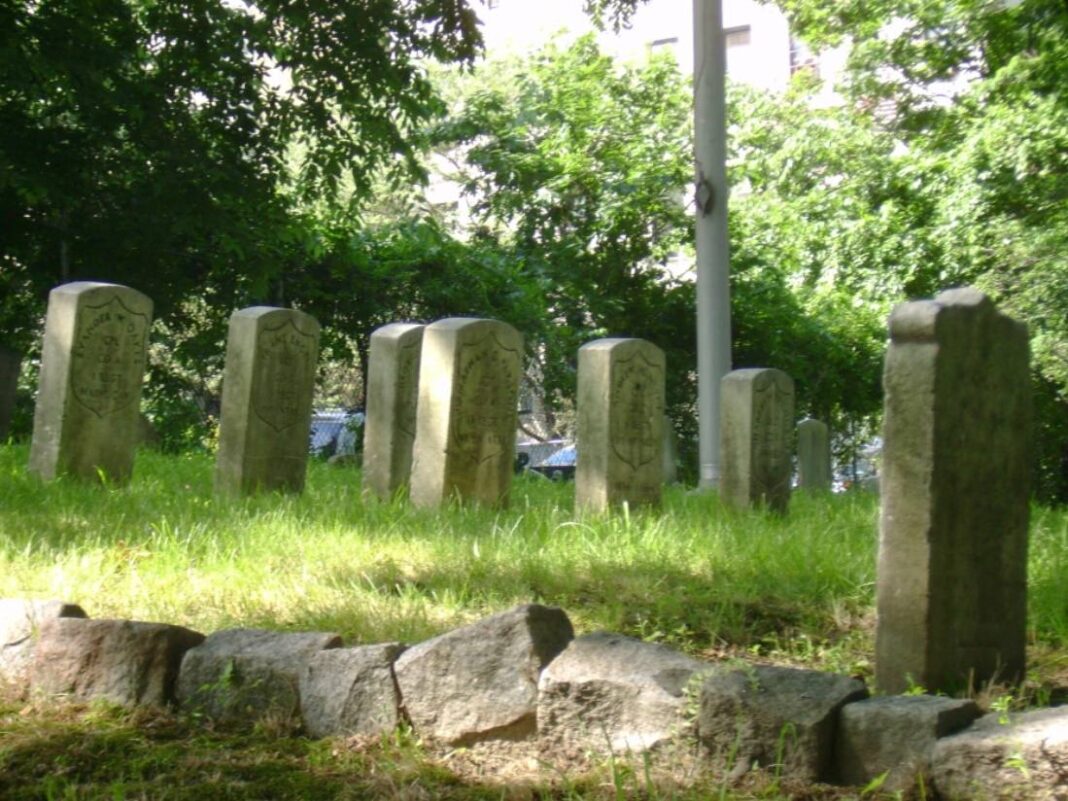

Right next to the Bronx Zoo, amid the massive buildings of the Lambert Houses housing complex, you can spot a strange sight: an old, damaged metal sign with a faded inscription—”West Farms Military Cemetery, Bronx Landmark, One Block West.” The cemetery itself is located at the corner of East 180th Street and Bryant Avenue. It’s the final resting place for 40 veterans who fought in the War of 1812, the Civil War, the Spanish-American War, and World War I. However, these soldiers are only part of the rich history of this cemetery, which has been a public burial ground since the early 19th century. Read on to learn more on bronx-yes.com.
Founding the Cemetery in the 19th Century
In the early 19th century, about 12 miles north of New York City, where the Bronx River begins, lay the small village of West Farms with a population of about 300 people. In 1814, the trustees of the First Presbyterian Church of West Farms purchased two plots of land on what is now 180th Street in the Bronx to build a church. One of these plots was the family cemetery of the Lawrence family, who owned a local farm. The Lawrences sold part of their land to the church, while retaining the right to be buried there as a family.
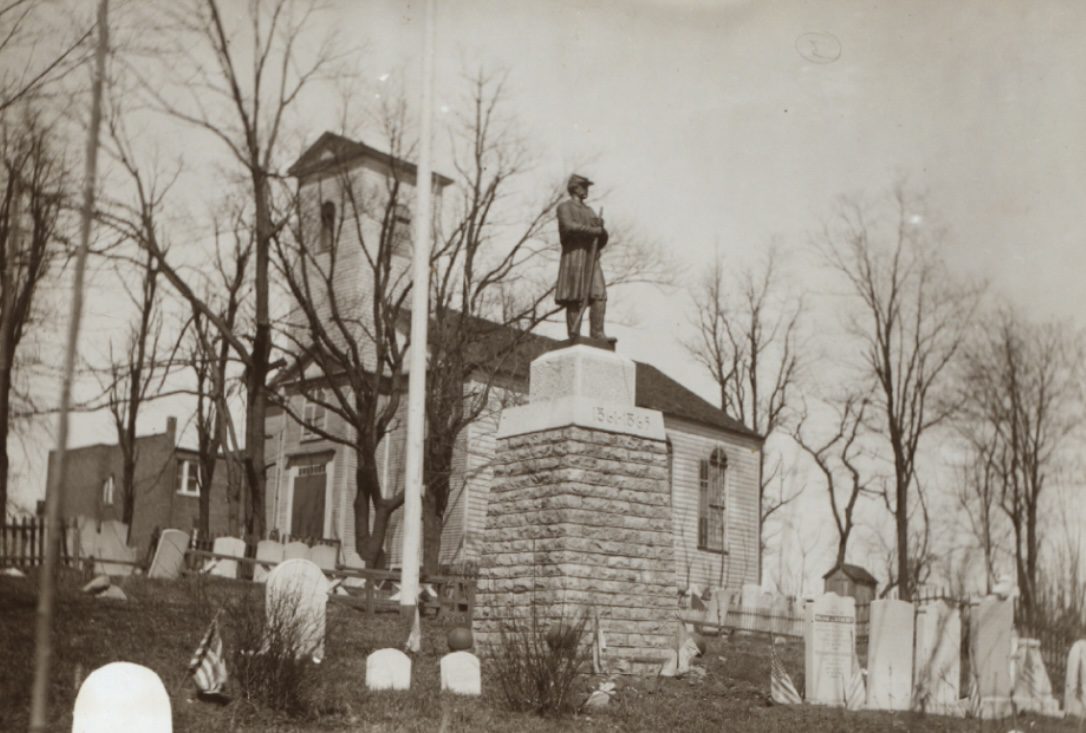
The church and its surrounding cemetery were built on a hill on the north side of the street in 1815.
The trustees designated a portion of the neighboring plot as a burial site for the poor and for Black slaves. In 1827, as the village began to grow, a farmer named John Butler bought a 100-by-200-foot plot of land east of the Presbyterian cemetery and established a public burial ground, which he divided into individual plots and sold directly. Although the two cemeteries initially existed separately, they eventually merged into one. In 1872, Butler sold the cemetery to his son, who resold it just a year later to Alfred Pettit. In 1882, Pettit sold it to Isaac Butler (no relation to the previous owners). After Isaac’s death in 1913, the land was inherited by his son William, and in 1925, by his children Frank, Roy, and their sister Florence Crooker.
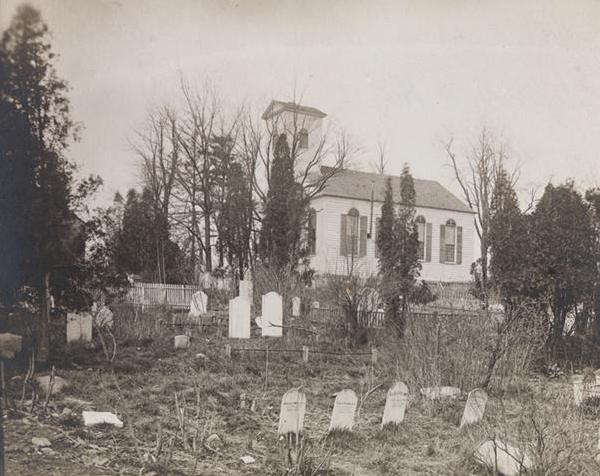
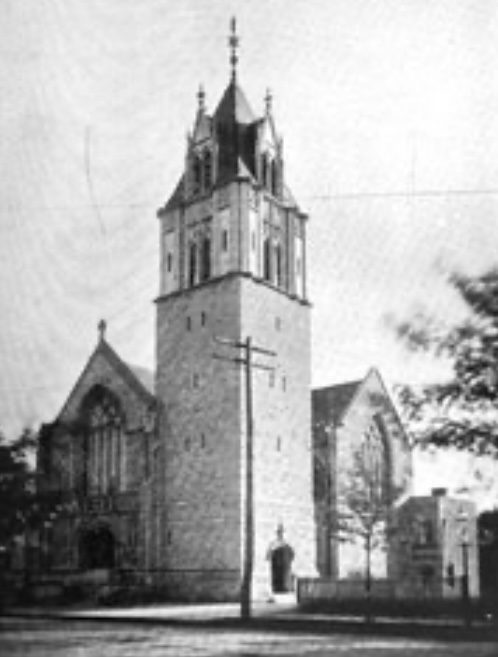
In the early 1900s, due to rapid urbanization, the West Farms Presbyterian Church moved from its original building on the hill to a newly constructed church across 180th Street—now the Beck Memorial Presbyterian Church. The old church was used as a gymnasium for some time until it burned down in 1948.
Neglect of the Cemetery
In 1908, the “New York Evening Telegram” reported that the West Farms Cemetery was in a state of extreme neglect—overgrown with blackberry bushes, covered in trash, desecrated, and forgotten. For example, Captain William Raspberry’s tombstone was surrounded by rusty tin cans, bottles, and other debris. By 1927, the vegetation had completely taken over, despite occasional cleanup efforts by community groups, including Boy Scouts and veterans.
During the redevelopment of the area, many burials were disturbed—both in the cemetery near the old church and in the forgotten burial ground for the poor on the south side of East 180th Street. After news of the desecration of veterans’ graves became public, local residents formed a committee to protect the cemetery. The cemetery was never officially closed, but its appearance and condition continued to decline year after year. The last known burial here was the grave of World War I veteran Valeriano G. Tolosa, dated 1929.
The property not owned by the West Farms Presbyterian Church was officially transferred to the city in 1954 after a long period of legal uncertainty. This was made possible by a year-long investigation by Bronx resident Tony Marotta, a former commander of a local American Legion post. While searching municipal archives, Marotta found letters and documents that indicated there were doubts about the legal status of the land transfer to the city in the 1930s. After further investigation, the heirs of the previous owners—Florence Crooker, Frank, and Roy Butler—were found and agreed to transfer the land to the city. This plot now belongs to the New York City Department of Parks.
Who Found Peace at the Cemetery
The first person buried at West Farms Cemetery in 1815 was Samuel Adams, a veteran of the War of 1812 and a member of the family that owned the land in the area. A nearby street is named after him.
This cemetery is the final resting place for veterans of four wars: two from the War of 1812, thirty-five from the Civil War, two from the Spanish-American War, and two from World War I.
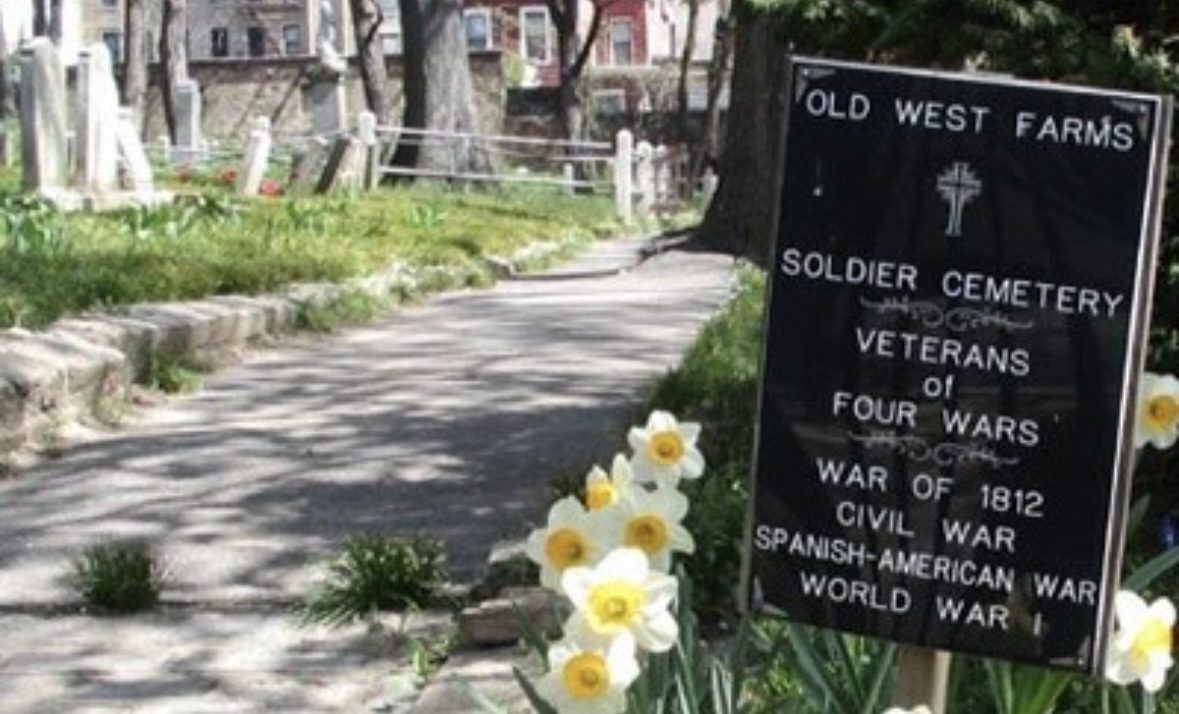
Among the notable individuals buried here are:
- Captain John Butler, a cavalryman from the War of 1812;
- Captain William Raspberry, who died in the Battle of Cedar Creek during General Sheridan’s raid;
- a sailor nicknamed “the Viking,” who served first on the USS Merrimack in the U.S. Navy and later in the army;
- Samuel Pierce, a member of the old landowning family from Tremont Avenue;
- Private Alexander Di Francisco, who was awarded the Silver Star for his bravery in World War I (a replica of the award is engraved on his tombstone).
As historian Lloyd Ultan explains, the large number of veterans buried here speaks to the deep patriotism of the residents of West Farms. They actively and voluntarily participated in the wars—especially the Civil War. Another researcher, Cancel, calls this cemetery a symbol of dedication and sacrifice:
“These guys really fought for history; they fought. They weren’t afraid, they just went out and did what they had to do to try to make this world a better place.”
On May 28, 1916, six unidentified bodies that had previously been buried on Hart Island were reinterred at West Farms.
Memorial Commemoration
A monument in the form of a bronze statue of a Union Army soldier on a pedestal was installed on the cemetery grounds. Three 19th-century field cannons were also added. Over time, the statue was damaged by weather and acts of vandalism, and it was removed around 1950. It was stored in an unknown location for several years until it was restored and returned on November 18, 1959. The Civil War Memorial Committee took on the task and initiated the restoration. The statue was stored by Bert Seck, an employee of the city’s Department of Public Works, a World War I veteran, and a historian. He delivered it to the coppersmith Andrew Betz’s workshop in Yonkers, where the restoration was completed.
On October 16, 1977, a memorial plaque was unveiled at the cemetery in honor of Mary Bowser, an African American woman from the South who spied for the Union Army during the Civil War. Working undercover as an illiterate servant in the home of Confederate President Jefferson Davis, she gained access to secret information, which she memorized and passed on to Union agent Elizabeth Van Lew. Van Lew, in turn, relayed the intelligence to General Ulysses Grant. The unveiling of the plaque was accompanied by a 21-gun salute from the National Guard.
Landmark Status
On December 27, 1966, the Landmarks Preservation Commission held an official public hearing on the proposal to grant landmark status to the West Farms Soldiers Cemetery and the adjacent property. Notice of the hearing was made public as required by law. During the meeting, one person expressed support for the initiative, and no objections were raised.
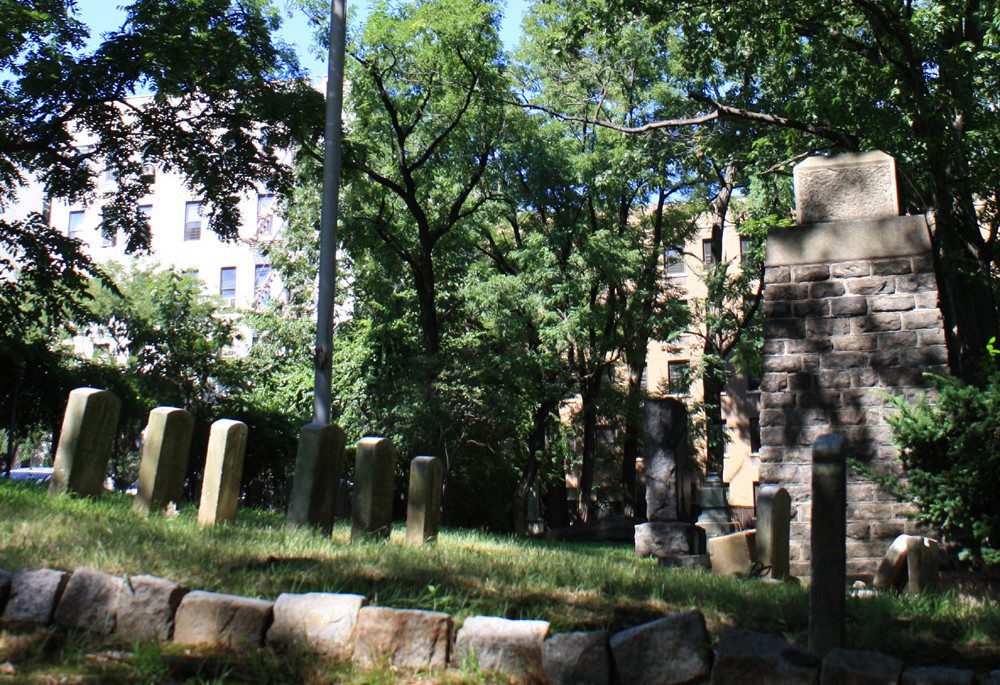
After a detailed analysis of the historical, architectural, and cultural significance of the site, the Commission concluded that the old West Farms Soldiers Cemetery has unique value as a historical and aesthetic object, important to the development and heritage of New York City. It was specifically emphasized that the site serves as a reminder of the past, as it is the final resting place of veterans who gave their lives for their country. Based on this, the Commission officially granted the West Farms Cemetery landmark status on August 2, 1967.
So, if you’re planning a walk through the Bronx, be sure to visit this old cemetery. Places like this always have a special, magical atmosphere and a sense of timelessness, thought, and feeling.